When most homeowners think about building a deck, the focus is almost always on what they can see: the boards, the railing, the color, the lighting.
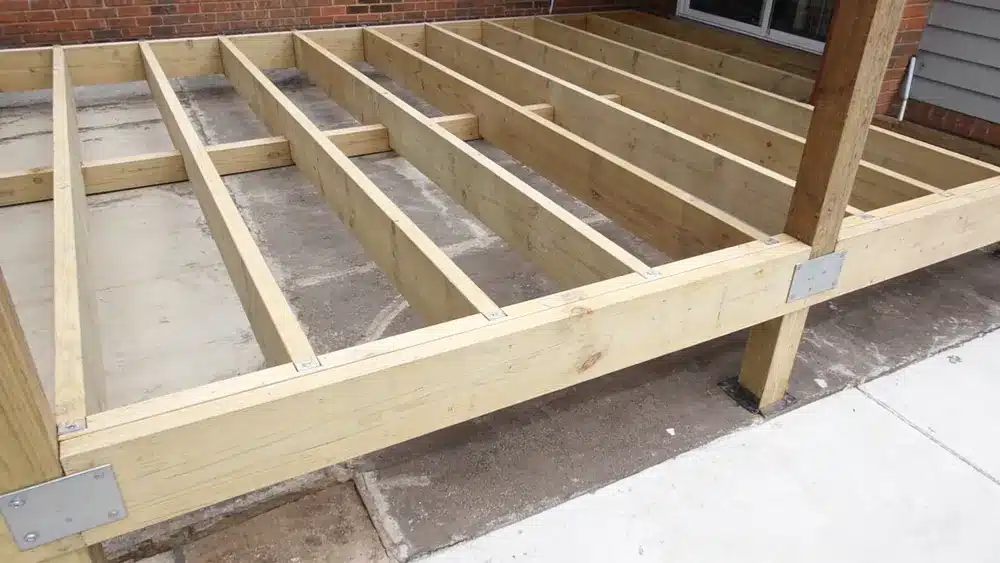
But from a structural standpoint, the most important part of any deck is the part you’ll never see once it’s built — the framing underneath.
The subframe determines:
- How long the deck actually lasts
- Whether the surface stays flat
- How solid it feels under load
- And how many repairs you’ll face over time
At Acumen Renovations, we’ve seen countless decks with great-looking surfaces fail because the structure underneath couldn’t keep up.
Simply put:
You can replace decking boards. You can’t easily replace bad framing. “Common deck building mistakes that shorten lifespan”
The Baseline: Pressure-Treated Softwood (“Yellow Wood”)
The vast majority of decks in Kansas City are built using what contractors call “yellow wood” — pressure-treated softwood, usually southern yellow pine.
This is the standard material used for:
- Joists
- Beams
- Ledger boards
- Posts
- Rim boards
It’s popular because it’s:
- Code-approved everywhere
- Affordable
- Easy to work with
- Widely available
Pressure-treated lumber is chemically treated to resist rot, decay, and insects, which makes it suitable for outdoor use.
But even with treatment, wood is still an organic material. It absorbs moisture, expands and contracts, twists, and slowly changes shape over time.
In Kansas City’s climate — with hot humid summers and freezing winters — that movement happens every year. Over time, this leads to:
- Uneven surfaces
- Loose rail posts
- Settling stairs
- Fasteners working loose
Not necessarily because the deck was built wrong — but because wood moves.
Premium Wood: ProWood® Pressure-Treated Lumber
Manufacturer: ProWood (UFP Industries)
ProWood is not a different type of material — it’s a brand within the pressure-treated lumber category.
Same species. Same structural role. Better treatment and quality control.
Compared to generic yard stock, ProWood typically offers:
- More consistent preservative treatment
- Better resistance to rot and insects
- Optional kiln-dried after treatment (KDAT)
- More predictable performance
Structurally, ProWood still behaves like wood — because it is wood.
But it’s a higher-quality version of the standard material most decks are built with.
ProWood Warranty
ProWood offers a Lifetime-Limited Warranty for residential use, covering structural failure caused by fungal decay or termite damage for the original homeowner.
This makes ProWood one of the strongest warranty-backed options in traditional wood framing.
Engineered Wood: PWT Treated™ LVL
Manufacturer: Pacific Woodtech (PWT)
This is where deck framing starts to move beyond traditional lumber.
LVL (laminated veneer lumber) is an engineered wood product made by bonding thin layers of wood together under pressure.
The result is a material that is:
- Stronger than sawn lumber
- Much more dimensionally stable
- Manufactured straight and consistent
When treated for exterior use, PWT Treated™ LVL can be used for:
- Joists
- Beams
- Ledgers
- Stair stringers
The biggest advantage is stability. LVL doesn’t twist, crown, or warp like solid lumber.
This makes it ideal for:
- Large decks
- Elevated decks
- Long spans
- Heavy loads (hot tubs, outdoor kitchens, pergolas)
Important Installation Requirement (This Matters)
PWT’s warranty requires joist flashing tape or approved flashing on all upward-facing surfaces.
Without it, the 25-year warranty is void.
PWT Treated LVL Warranty
PWT provides a 25-Year Limited Warranty against damage caused by fungal decay and wood-destroying insects, when installed according to their guidelines.
Next-Generation Framing: Evolution Steel Deck Framing
Manufacturer: Fortress Building Products
Steel deck framing removes organic material entirely.
Instead of treated wood, the structure is built from:
- Galvanized steel
- Powder-coated framing members
- Engineered connection systems
Steel framing offers:
- No warping
- No shrinkage
- No rot
- No insect damage
- Minimal long-term maintenance
It also allows:
- Longer spans
- Fewer posts
- More open layouts
- Better performance under heavy loads
Fortress Evolution Warranty
Fortress provides a 25-Year Limited Warranty covering manufacturing defects and structural integrity. The warranty is prorated over time.
Kansas City Climate Reality
Midwest decks face:
- High humidity
- Seasonal freeze-thaw cycles
- Heavy rainfall
- Expansive clay soils
These conditions accelerate framing problems, not surface problems.
Who Should Use What
- Standard PT wood → Budget-friendly, traditional builds
- ProWood → Higher-quality traditional framing
- PWT Treated LVL → Large decks, long spans, heavy loads
- Steel framing → Premium decks, long-term ownership “How long decks last depending on how they’re built”
Choose Strength That Lasts — Not Just What’s Familiar
Wood, engineered, or steel subframing — the choice you make now determines how well your deck performs for years to come.
Every material has a role. Every connection matters. And the wrong subframe can cut decades off your deck’s life or cost more in repairs than you ever saved.
If you want expert insight before you decide:
Schedule your consultation and find the best subframing solution for your deck.
Final Recommendation from Acumen Renovations
Most homeowners choose decking based on appearance.
We design decks based on what will still be standing decades from now.
The framing system is the foundation of everything above it — and once the deck boards go on, that structure is buried forever.
Choosing the right framing upfront is the difference between:
- A deck that quietly performs for decades
- A deck that slowly becomes a recurring problem
At Acumen Renovations, we believe the smartest investment in any deck isn’t what you see — it’s what you never will. “why some deck safety issues go unnoticed until failure”
FAQ
What is the best deck framing material in Kansas City? It depends on the project. Pressure-treated wood works for many decks, but treated LVL and steel provide better long-term stability in Kansas City’s climate.
Does ProWood last longer than regular pressure-treated lumber? Yes. ProWood uses enhanced treatment and quality control and offers a lifetime-limited residential warranty.
Is flashing required for LVL deck framing? Yes. PWT Treated LVL requires flashing tape or approved flashing on upward-facing surfaces to maintain warranty coverage.
Is steel deck framing worth it? For large or long-term decks, steel often provides the best overall value due to minimal maintenance and superior structural performance.