Most deck failures don’t happen because someone completely ignored building codes.
They happen because the deck was built without understanding how the system actually works over time.
In Kansas City, we routinely inspect decks built by:
- DIY homeowners
- New or inexperienced contractors
- Contractors cutting corners to hit a price point
Many of these decks look fine when finished—but develop serious safety issues years later.
This article breaks down the most common mistakes we see, why they’re dangerous, and how they lead to premature failure.
The Core Problem: Treating a Deck Like a Platform Instead of a Structural System
A deck is not just a flat surface with posts underneath it.
A properly built deck relies on:
- Correct load paths
- Proper connections
- Adequate redundancy
- Long-term moisture management
When any of these are misunderstood—or ignored—the deck may function temporarily, but it will not age safely.
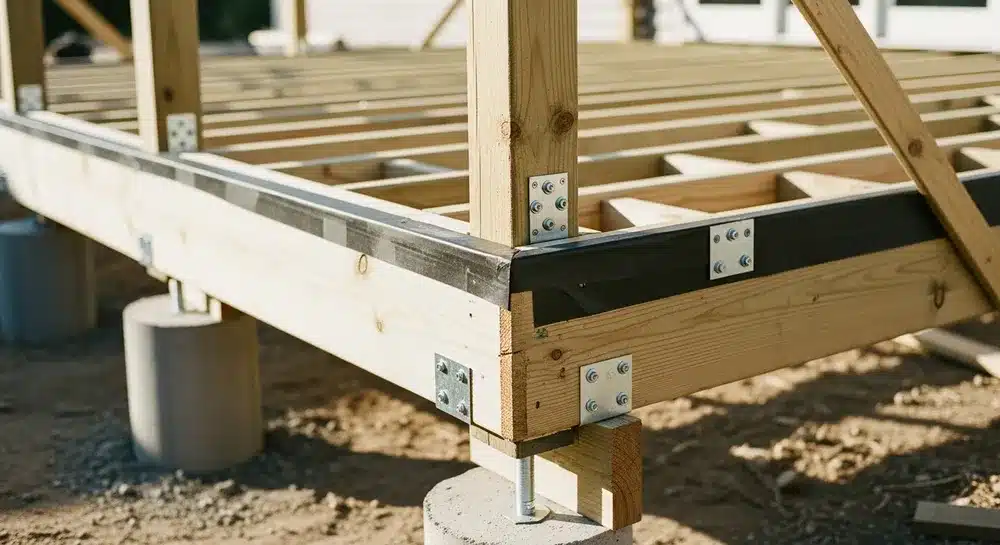
Mistake #1: Poor Post and Pier Design
This is one of the most common and most dangerous issues we see.
What Goes Wrong
- Posts placed too close to or below grade
- Concrete piers poured below surrounding soil
- Posts embedded directly in the ground
- Inadequate soil compaction
Why It’s a Problem
Posts are intended to transfer loads vertically into the ground.
When posts rot or piers settle, loads are redistributed laterally into components that were never designed to carry them.
This often leads to:
- Deck settlement
- Stress on beams and joists
- Pulling forces on the ledger board
- Compromised connections throughout the system
Once a deck begins to settle, it is no longer behaving as designed.
Mistake #2: Improper Ledger Board Attachment
Ledger attachment is one of the most misunderstood aspects of deck construction.
What We Commonly See
- Ledger boards fastened through siding
- Missing or incorrect flashing
- Improper fastener type or spacing
- Assuming fasteners alone handle the load
Why This Is Critical
The ledger transfers deck loads into the house.
When this connection is compromised, the deck begins pulling against the structure—often damaging the rim board, floor system, and wall framing.
Once flashing is compromised, water intrusion accelerates deterioration behind the scenes.
Mistake #3: Assuming Code Minimums Equal Best Practice
Code sets minimum safety standards, not long-term durability standards.
We often see:
- No joist flashing tape
- Minimal post clearance above grade
- Economy-grade treated lumber
- No redundancy in railing systems
Meeting code does not guarantee longevity or safety over time.
Mistake #4: Ignoring Moisture Management
Moisture is the silent killer of decks in Kansas City.
Common oversights include:
- No joist flashing tape
- Poor drainage around piers
- Trapped moisture between decking and framing
- No allowance for drying
Even pressure-treated lumber deteriorates when it stays wet—especially under composite decking, which sheds water onto the framing below.
Mistake #5: Treating Railings as a Finish Detail Instead of a Safety System
Railings are one of the most misunderstood—and most dangerous—areas of deck construction.
Why Railings Fail Without Warning
We regularly see railings that:
- Look solid
- Don’t visibly move
- Appear “well built”
But are actually:
- Relying on corroded fasteners
- Missing critical connections
- Dependent on weakened wood fibers
Deck settlement, ACQ fastener corrosion (common in early-2000s decks), and installation errors often leave railings one failure away from collapse.
“Why deck safety issues are often missed until it’s too late”
A Critical Railing Mistake We See All the Time: Attaching Posts to the House
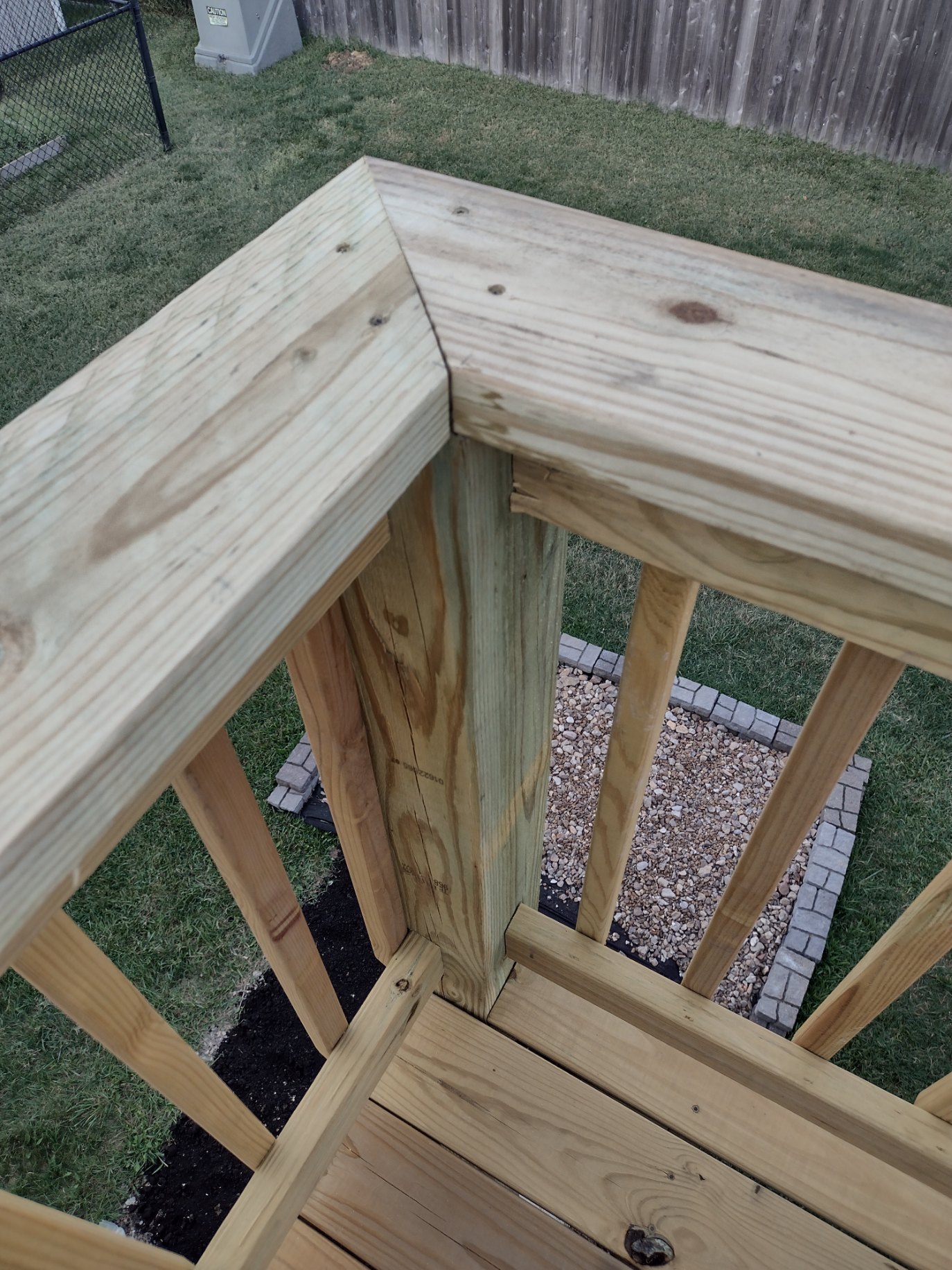
The number one railing mistake we see from DIY builders and inexperienced contractors is attaching a post—or a block of wood—to the house just to terminate a handrail section.
It’s extremely common, and it creates multiple problems at once.
Why This Is a Serious Problem
1. Unnecessary Siding Penetrations
Fastening posts or blocking to the house:
- Penetrates siding that doesn’t need to be penetrated
- Often bypasses proper flashing
- Frequently voids siding manufacturer warranties
There is no structural reason to penetrate siding just to support a railing.
2. Long-Term Maintenance Becomes Impossible
Wood posts require:
- Painting or staining
- Inspection
- Drying space
When a post is tight to—or attached to—the house:
- Finishes fail prematurely
- Moisture gets trapped
- Rot often starts where you can’t see it
3. The Connection Is Often Not Structural (Most Dangerous Issue)
In many cases, the post or blocking is:
- Fastened only to trim or boxing
- Not tied into house framing
- Relying on finish materials for strength
That means the railing may feel solid initially—but has very little real load capacity.
A railing system should never rely on non-structural house components for safety.
“How long decks actually last in Kansas City”
How Professional Railing Design Reduces Risk
At Acumen Renovations, we design railing systems to be:
- Structurally independent of the house
- Properly attached to deck framing
- Built with redundancy
On wood decks, this often means over-the-post railing systems that tie all posts together into a single structural unit. This distributes loads across the entire system instead of relying on isolated connections.
If aesthetics are a concern, we can still achieve the look of between-the-post railings while maintaining structural redundancy.
Mistake #6: Designing for Appearance Instead of Load Paths
Some decks look beautiful—but are structurally inefficient.
Common examples:
- Long spans without adequate beam support
- Decorative layouts that compromise structure
- Stairs and railings added without considering load transfer
Decks must be designed so loads travel:
- From the deck surface
- Through framing
- Into posts
- And down into the ground
When that path is interrupted, stress moves elsewhere—and failure follows.
Mistake #7: Not Thinking About Long-Term Service Life
DIY builders and inexperienced contractors often focus on:
- Getting the deck built
- Passing inspection
- Minimizing upfront cost
What’s often ignored:
- How components age together
- Moisture exposure over decades
- Material mismatch (long-life decking on short-life framing)
This leads to decks that:
- Look good early
- Become risky later
- Require premature replacement
Final Thought: Experience Shows Up Years Later
The difference between a well-built deck and a problematic one is rarely obvious on day one.
It shows up:
- After several freeze-thaw cycles
- After years of moisture exposure
- When loads increase
- When one connection finally fails
A deck should not just look good when finished—it should still be safe decades later.
“What credentials actually mean when hiring a deck contractor”
Don’t Learn This the Hard Way
Most deck failures don’t happen overnight — they’re built in from the start.
Small mistakes in structure, materials, or installation can turn into expensive (and dangerous) problems later. Poor framing, bad fasteners, and weak foundations are some of the most common issues seen in DIY or inexperienced builds.
If you’re planning a deck, make sure it’s done right from day one.
Schedule your consultation and build with confidence.
Q&A: Common Deck Construction Mistakes
What is the most common mistake DIY deck builders make?
Improper post, pier, and railing connections are the most common and dangerous mistakes. These issues often lead to settlement, load redistribution, and sudden failures.
Why is attaching railing posts to the house unsafe?
Because it creates unnecessary siding penetrations, maintenance traps, and often relies on non-structural materials for safety—leading to hidden failure risks.
Is building to code enough for a long-lasting deck?
No. Code sets minimum standards. Long-term safety requires proper moisture management, redundancy, and understanding how decks age in real conditions.